Why ad platforms miss your sales, and how first-party tracking fixes it
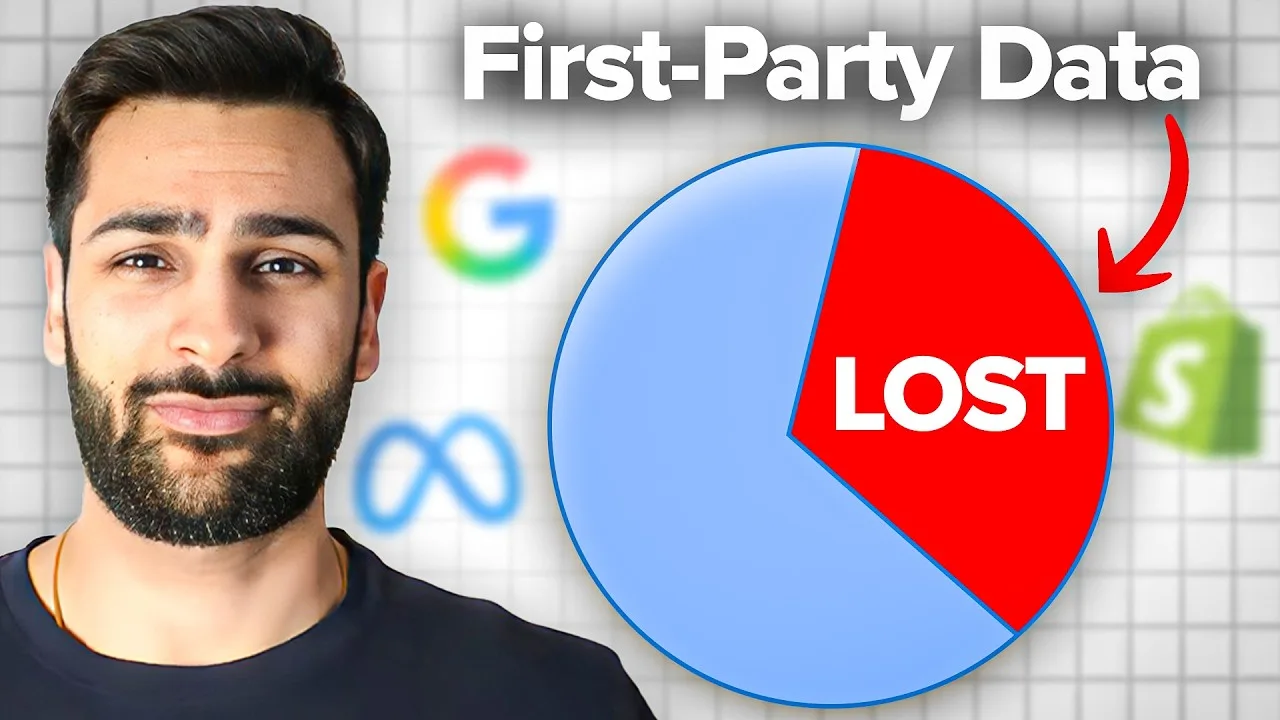
Every ad platform puts its own pixel in your customer's browser, and browsers now block those pixels or wipe their cookies, so Meta, Google and TikTok often miss 20 to 30% of your sales. The fix is first-party data infrastructure, one tracking setup you own on a subdomain of your website that sends events server-side to every platform and remembers customers on your own server. The platforms then see close to all of your sales, so they learn from the full picture and scaling gets more stable.

Manu Verma, founder of Nuver Digital22 October 2026 · 4:38 video · 5 min read
 4:38
Key takeaways
- Every platform has its own pixel on your site: Meta, Google, TikTok and your email platform. They all live in the browser, and the browser no longer trusts them.
- Often 20 to 30% of conversions never make it back to the platforms. Every sale Meta doesn't see is a sale it can't learn from.
- Because cookies get wiped, platforms can't remember returning visitors. Meta keeps prospecting them, and your email flows don't fire.
- First-party data infrastructure replaces all those pixels with one setup you own, on a subdomain of your site, that collects the data once and sends it to every platform.
- Server-side tracking sends events from your server straight to the platforms, so they go from seeing maybe 70% of your sales to close to all of them.
- Owning the data lets you see the full customer journey, so you stop cutting ads that bring people in but don't get the last click.
If you’re running paid ads, there’s a good chance Meta, Google and TikTok are only seeing part of what’s happening on your website. When the algorithm works with incomplete data, you pay more for every customer. First-party data infrastructure is what fixes that, and it sits underneath every brand we manage, from $100K a month up to global brands doing 8 and 9 figures.
Why can’t Meta, Google and TikTok see all your sales?
When someone visits your website, a pixel watches what they do: viewed a product, added to cart, bought. The part most people don’t think about is that every platform has its own pixel. Meta has one, Google has one, TikTok has one, and your email platform has its own tracking code too. That’s four or five separate pieces of code on your site, each one tracking your visitors and reporting back to its own platform.
They all live in the person’s browser, and the browser doesn’t trust them anymore, because technically they belong to Facebook and Google, not to your website. So:
- iOS privacy settings block them.
- Ad blockers kill them.
- Safari deletes their cookies within about seven days, sometimes within 24 hours.
How much sales data are you losing?
A decent chunk of your conversions, often 20 to 30%, never make it back to the platforms. The sale happened. You got paid. Meta never saw it.
That matters more than the reporting gap. Every sale Meta doesn’t see is a sale it can’t learn from, so it gets worse at finding your next customer. The result is weaker targeting, a higher CPA and shakier scaling.
Why do returning customers get treated like strangers?
There’s a second problem almost nobody talks about, and that’s memory. Because the cookies get wiped, the platforms can’t remember anyone.
Someone visits your site and comes back 29 days later, and Meta treats them as a completely new person, so it keeps spending your money prospecting them.
Your email platform is worse. Someone signs up to your list, comes back a few weeks later, and Klaviyo doesn’t recognise them. No abandoned cart flow, no browse abandonment, nothing fires. Instead they get the welcome pop-up asking them to sign up again. You’ve probably had that happen to you as a customer.
What is first-party data infrastructure?
It replaces all of those separate pixels with one tracking setup that you own. One system runs on a subdomain of your own website, something like track.yourbrand.com, collects the data once, and sends it out to Meta, Google, TikTok and Klaviyo.
Because it belongs to your website, the browser treats it as first-party and doesn’t block it the way it blocks the platform pixels.

What does server-side tracking change?
The second piece is server-side tracking. Instead of the browser reporting each sale, your server sends the events directly to the platforms.
| How the sale is reported | Can it be blocked? |
|---|---|
| Browser to platform | Yes |
| Server to server | Pretty much no |
So the platforms go from seeing maybe 70% of your sales to close to all of them. ROAS usually improves fairly quickly, because the algorithm finally has the full picture, and scaling gets more stable too.
How does it fix customer memory and your email flows?
The third piece is memory. Who’s who no longer lives in the browser. It lives on your own server.
So when the browser wipes its cookies, your system still knows exactly who that person is, even across devices once they’ve identified themselves somewhere, like clicking through from one of your emails. That means:
- The person who comes back a month later gets recognised.
- The right flows fire.
- The pop-ups stop treating them like a stranger.
- Your abandoned cart emails actually reach the people who abandoned carts.
Across a year, that’s a serious amount of recovered revenue.
Why does attribution beyond the last click matter?
The fourth layer is attribution. Once you own the data, you can see the full customer journey, not just the last click: which ad someone clicked the very first time they visited, which ad closed the deal, across different time windows.
That matters because some ads are really good at bringing new people in but never get the credit, since a different ad closes the sale a week later. Cut that first ad because it looks bad on last click, and you’ve switched off the tap that fills the funnel.

On top of that, we’ve built our own system that connects this journey data into AI. It analyses every campaign, ad set and ad across different time windows and shows where each one contributes to the journey: first click, somewhere in the middle, or last click. That way we’re assessing ads on the role they actually play. As far as we know, we’re one of the first in the country to build this out, and we expect to see a lot more of it over the next few years.
How hard is first-party tracking to set up?
Getting the infrastructure set up is fairly technical. You’re adding records to your domain and connecting your store, your ad accounts and your email platform.
We work directly with these platforms, have agency deals with them, and set up first-party data tracking and attribution as standard for the brands we work with.
What else decides whether this works?
Tracking is the foundation, not the whole game. You still need creative that converts, an offer strong enough to scale, and a campaign structure that tests and scales properly.
Once your data is clean, the structure is what turns it into growth. Start with the ABO + CBO hybrid framework, or if you’re working with a smaller budget, how to scale Meta ads on a small budget.
Questions people ask
How much sales data are Meta, Google and TikTok missing?
Often 20 to 30% of your conversions never make it back to the platforms. Their pixels live in the browser, where iOS privacy settings block them, ad blockers kill them and Safari deletes their cookies within about seven days, sometimes within 24 hours. The sale still happens, the platform just never sees it.
What is first-party data tracking?
It replaces each platform's separate pixel with one tracking setup that you own. It runs on a subdomain of your own website, something like track.yourbrand.com, collects the data once and sends it to Meta, Google, TikTok and Klaviyo. Because it belongs to your website, the browser treats it as first-party and doesn't block it the way it blocks the platform pixels.
What does server-side tracking do?
Instead of the browser reporting each sale, your server sends the events directly to the platforms. Browser to platform can be blocked; server to server pretty much can't. The platforms go from seeing maybe 70% of your sales to close to all of them.
Why doesn't Klaviyo recognise people who are already on my email list?
Because the browser wipes the cookies that identify them. Someone signs up, comes back a few weeks later, and Klaviyo treats them as a stranger: no abandoned cart flow, no browse abandonment, and the welcome pop-up asks them to sign up again. With first-party infrastructure, who's who lives on your own server, so they get recognised and the right flows fire.
Does fixing tracking improve ROAS?
Usually, and fairly quickly, because the algorithm finally has the full picture of your sales to learn from. Scaling gets more stable too. But tracking is the foundation, not the whole game: you still need creative that converts, a strong offer and a campaign structure that tests and scales properly.

Manu Verma
Founder of Nuver Digital, an ecommerce paid ads agency in Sydney. Close to a decade in paid ads and more than 300 ecommerce brands. On YouTube he breaks down what's working in Meta, Google and TikTok ads, pulled straight from the accounts Nuver manages.